This respirator complies with Chinese standards GB2890-2022 and GB2626-2019,which can provide respiratory protection against certain air pollutants, and the shape of the face fits well with the air tightness effect, which is suitable for long time wearing.
I. Important notes
Before use,the user must read and understand this product manual.
This instruction manual contains very important information that must be read in its entirety and understood by any user who is going to use or maintain this respirator.Only the user who fully understands what is presented in this manual should use or maintain the respirator. Regarding the warning section,failure to follow the warning section can seriously damage the respirator and put the user's life at risk.
II. Warning
Read the information printed on the pouch and the instructions inside the pouch carefully before use.Misuse of this product or use of this product without following the warnings printed on the package and the instructions inside may result in illness or death.
- Ensure that the appropriate mask is selected for use.The mask must fit snugly over the face.be worn for the duration of contaminant exposure,and replaced as
necessary;
- This respirator does not provide oxygen and should only be used in a well-ventilated environment.do not use it in an environment with an oxygen concentration
of less than 19.5%;
- The appropriate filter element must be selected according to the concentration and type of contaminant in each situation. Do not use in environments where the
concentration of contaminants is unknown,reaches Immediate Life and Health Threatening Levels(IDLH),or where the concentration exceeds that specified in the
applicable local standard.
- Two(1)filter elements must be installed on each respirator;
- Must not be used for protection against carbon monoxide under any circumstances;
- Modification,abuse,and misuse of masks,filter pads,and cartridges are not permitted
- This respirator with filter elements must not be used in containers,wells,sewers or ventilate confined spaces;
- Do not use this mask if there is a beard or other influencing factor that prevents a good fit between the face and the edge of the mask;
- This respirator does not protect against other parts of the body exposed to contaminants.If environmental vapors,gases,or airborne dusts can irritate or burn the
skin or can be absorbed by the body through skin penetration,specific hand protection products or protective clothing are required;
- Leave the work area immediately if your respirator is damaged,you have difficulty breathing,or you become dizzy or nauseous.
Pre-use instructions
- The following information must be known before using this respirator: Hazardous substances and concentrations; This respirator is approved for protection against specific hazardous substances and specific concentrations; confirmation that hazardous substances in the environment are not immediately dangerous to life or health(IDLH); you have a good fit while wearing this respirator; that you do not have any physiological deficiencies or illnesses that prevent you from using this respirator;
- Ensure that all parts of the respirator are intact:including the head frame,head strap,inhalation and exhalation valves;
- Inspect the respirator to ensure that there are no signs of breakage or cracks on any of the parts.If this is the case,the respirator must be discarded;
- Ensure that the appropriate filter element is selected according to the concentration and type of contaminant in each case;
- Two(one set)filter elements must be installed on each respirator.
- Training:This instruction is not a substitute for a formal respirator training program.Training should include actual operation of the respirator,inspection,fit verification,verification of mask-to-face seal,familiarization with the respirator in a normal environment,and finally,trial use in a test environment;
- Fit Testing:The respirator should only be used by a user who has undergone a fit test and the results indicate that the respirator fits the face well.The fit test should be performed at least once a year,but more often if there are events such as weight changes or dental procedures that may affect the fit of the respirator. The number of tests should be increased
- Air Tightness Test:Prior to entry into a hazardous environment,or if the respirator is used regularly in a hazardous environment,the respirator must be tested for positive or negative air tightness to ensure that the mask edges seal effectively against the face.Refer to the "Respirator Instructions" section of this manual for user's respirator air tightness testing instructions
Warning: Do not enter a potentially hazardous environment until all of these factors are recognized.
III. Instructions for the use of respirators
This respirator consists of a half mask and replaceable cartridges or pads for protection against harmful vapors,gases or dusts,depending on the type of cartridge or pad selecte.During inhalation,harmful air passes through the cartridges or pads,and these filter element,depending on the typ,absorb the harmful vapors,gases or
dusts before the air enters the body.During inhalation,the inhalation valve of the respirator opens while the exhalation valve closes to prevent harmful air from being drawn back into the mask.When exhaling,the exhalation valve opens and the inhalation valve closes to prevent re absorption of exhaust air.
Warning:The face piece and filter element of this respirator can be ordered separately;do not use the respirator without the appropriate filter element.
3.1. Inspection of masks
- The user must carefully check that the respirator is in good condition before and after each use;
- Check that the mask is not torn,cracked or contaminated,and that the mask does not deform and is made of soft material when attached to the face;
- Check the expiatory and inspiratory valve blades to make sure they are not broken,deformed,cracked or contaminated,and check the valve seats to
- Check the headband to make sure the elastic is good and that it is not unraveled,cracked or dirty;
3.2. Mask wearing
- Adjust the size of the head stock until it fits your head;
- With one hand,place the mask over your mouth and nose,and with the other hand,secure the headgear to the top of your head by adjusting the end of the headband at the headgear to hold the mask in place over your mouth and nose and against your face(Fig.1);
- Place the bottom headband behind the neck and attach with the hooks(Fig.2);stretch the headband at each end until the mask is in comfortable contact with the face and fits snugly;

3.3. Assembly and disassembly of cartridges/cottons/cotton caps
- Check that the cartridge/cotton/cotton cover is in good condition and within the expiration date;
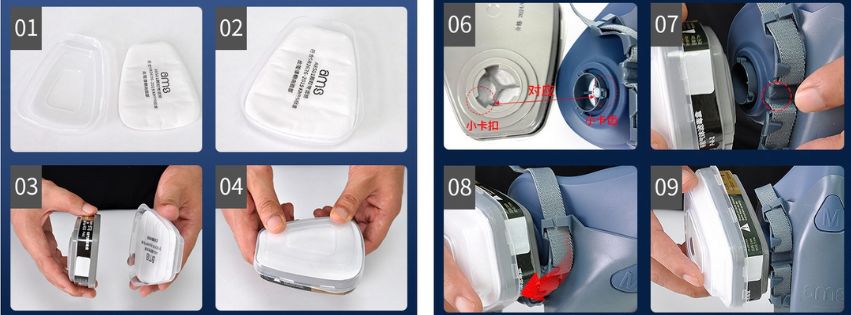
- Open the clips made by the filter cotton accept and place the filter cotton into the accept holder, with the lettered side facing the face(Fig.3);
- When fog is present in the air, particulate filter pads must be used in conjunction with the cartridge;
- Place the filter cotton in the filter cotton cover with the lettered side facing the cartridge and press firmly(Fig.4);
- Snap the tabs on the filter element into place in alignment with the base of the interface on the respirator(Fig.5);
- Turn the cartridge clockwise to the locking position and counterclockwise to remove the cartridge(Fig.6).
3.4. User-performed airtightness check
Always check the fit of your respirator to your face before entering a contaminated area.
Positive pressure air tightness check
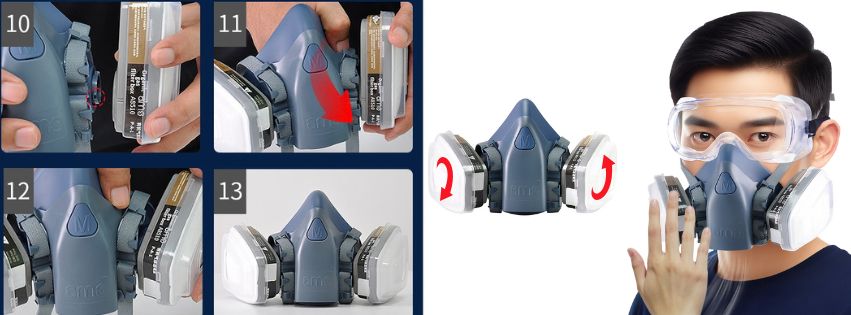
Raise the head slightly, cover the exhalation valve outlet at the front or lower side of the mask with the palm of your hand and gently exhale. If the mask bulges slightly and there is no air leakage between the face and the mask, the fit is good(Fig.7).
Negative pressure air tightness check
Cover the surface of the cartridge with the palm of your hand or press the palm of your hand on the center part of the filter cotton receiver to restrict the airflow into the filter cotton, gently inhale,if you feel the mask collapsing slightly and close to your face,and there is no air leakage between your face and the mask, it means that the fit is good;
If you feel an air leak, reposition the mask or adjust the head strap elasticity to eliminate the leak. Repeat the above steps until a good fit is achieved;
If you are unable to obtain a good facial closure and are not allowed to enter a contaminated area, ask your supervisor for assistance.
IV. Cleaning and Disinfection
Warning:Do not use solvents for cleaning.Solvent cleaning may cause deterioration of respirator components and reduce respirator effectiveness
Remove the filter element before cleaning the respirator; Clean the respirator with a damp cloth, soak it in warm water not exceeding 50°C,use a neutral detergent if necessary, and air-dry it in a contamination-free
environment
V. Maintenance
To keep the respirator in optimum condition,the following should be done after each use.
Clean and store in a completely dry zip lock bag;
Check the inhalation and exhalation valves and keep them completely clean and free from any deformation;
Make sure the elasticity of the headband does not decrease;
Make sure there are no signs of tears,cracks or dents on any part of the respirator;
If any deformation occurs in any part,the respirator must be replaced.
VI. Storage and disposal
The respirator must be stored in a sealed bag in a dry place at room temperature,away from contaminants;
Do not expose the respirator to temperatures exceeding 50 degrees Celsius or to direct sunlight;
Discard used respirators in accordance with local regulations.Improper disposal of respirators,cartridges,and filter pads contaminated with toxic or hazardous substances can lead to environmental hazards
VII. Validity Period
The respirator has an expiration date of 5 years from the date of manufacture and should be stored and sealed in its original packaging in accordance with the recommended storage conditions given on the bag and instructions.
VIII. Usage Restrictions
Respirators should be used within the period of use indicated on the packaging.The effective protection time of the respirator is determined by the intensity of the wearer's work,the type and concentration of the contaminant,and the temperature and humidity of the environment.Replace the respirator on a reasonable schedule or when the wearer smells,tastes,or feels irritation from the contaminant or when there is a significant increase in inspiratory resistance,whichever comes first.